
US CPI a rollercoaster, but petflation trends down in September

Economic fatigue continues, but pet owners are proving consistently resistant. | Lucas, Unsplash
September 2026’s Petflation report, put together monthly by John Gibbons at Pet Business Professor, shows almost all pet segments coming down from August numbers, even as the overall economic rollercoaster continues.
BY Lindsay Beaton, Founder/Principal
Beaton Path Communications LLC
Petflation, the U.S. pet segment-specific inflation tracked monthly by Pet Business Professor President John Gibbons, decreased to 2.2% in September 2026, a full percentage point down from the 3.2% seen in August, according to Gibbons’ report. Notably, this number is lower than the total Consumer Price Index (CPI) for September, which stood at 3.7% — up versus September 2025’s 2.4% and up. 0.06% from August 2026. (The target inflation rate for the U.S. is <2%, meaning the country is still well above target overall.) In more positive pet news, every segment except for Veterinary saw a decrease from August (Food: -0.02%, Supplies: -0.8%, Services: -1.2%, Vet: +0.3%).
What does this mean for pet owners?
Of course, an overall CPI increase means more pressure on consumers, regardless of pet’s numbers. According to the U.S. Bureau of Labor Statistics, which publishes the numbers each month, “the index for gasoline rose 9.1% in September, accounting for over half of the monthly all items increase.” The energy index increased 5.2% over the month following a 2.1% increase in August, accounting for another big chunk of overall inflation. In this case, both perception and reality are reality, and when consumers are filling up their vehicles once or so a week (versus buying pet food once a month or every six weeks), the price fatigue builds up a lot faster. And when the one segment of pet that has steadily increased for years now is the primary segment consumers are using to maintain their pets’ health, the pet owner-specific fatigue is even more pronounced.
Still, pet owners are showing a willingness to continue giving it their best shot when it comes to taking care of their animals’ nutritional needs. According to Tractor Supply’s “The 2026 Canine Care Report,” published in September, dog owners said they’d be willing to spend US$36 more per month on dog food (US$137 versus $101) if they were confident it would meaningfully improve their dog’s health.
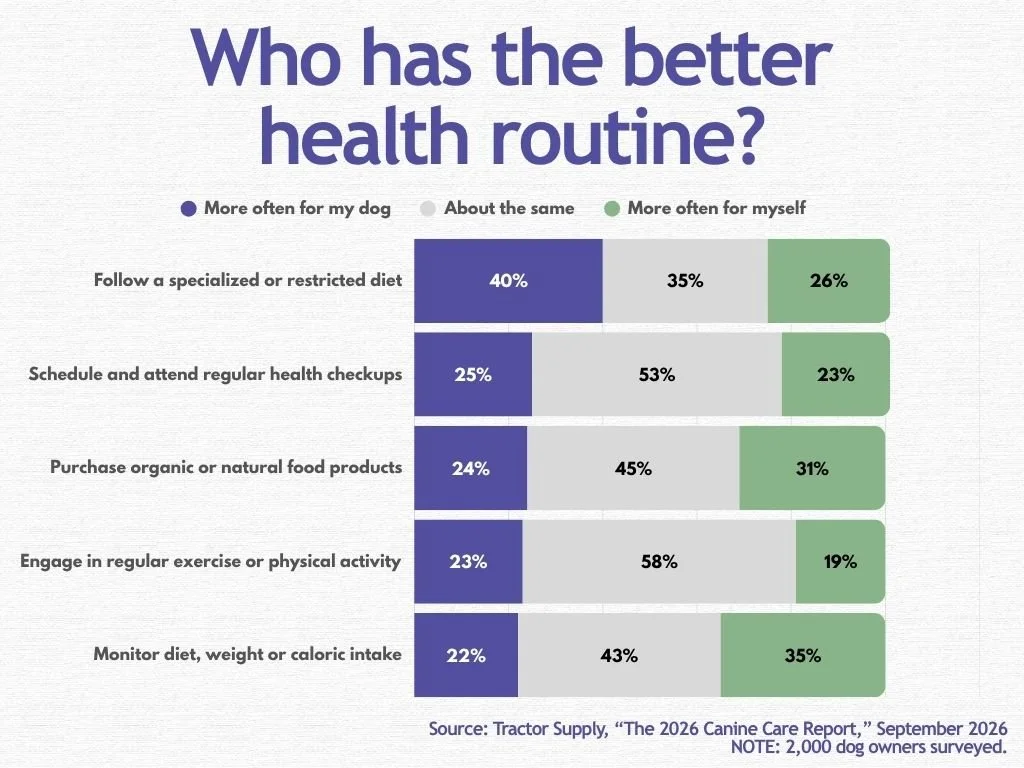
Pet owners continue to prove that their pets are a top priority when it comes to health and wellness. | Data pulled from Tractor Supply’s “The 2026 Canine Care Report.”
“Diet came out as the most dog-prioritized category by a wide margin,” said Tractor Supply’s report. “Forty percent of dog parents say they follow a more specialized or restricted diet for their dog than they do for themselves, and 24% buy organic or natural food products more often for their dog than for their own kitchen. A quarter of dog parents (25%) also say their dog attends regular health checkups more often than they do.”
In fact, “The average dog owner spends … more than US$1,200 a year [on pet food], with US$86 of that going toward premium, fresh or organic options,” said the report. “More than half of dog parents (51%) already spend on premium food in some form.”
That willingness to spend more, according to Tractor Supply, is strongest among younger generations. Gen Z spends the most on food overall (US$107/month), 24% more than Baby Boomers (US$86). What’s more, Gen Z would go as high as US$148 a month compared to US$110 for Boomers, nearly double the US$21 gap seen in current spending.
“Younger dog parents are spending more now and are the most willing to spend more if given a reason to,” said the report.
What does this mean for the pet industry?
The economy-resistant and persistent prioritization of pets continues for a large swath of pet owners, in spite of a now long-term slide into more and more expensive costs of living. The numbers are all there, and so are the surveys: consumers overall are exhausted, their wallets stretched thin as they get less product for more money at the gas pump, the grocery store and everywhere else they’re trying to shop.
And yet.
Pet owners simply will not compromise when it comes to their animals. There’s a good reason why the industry is compared to the baby segment of consumer goods; adults would rather skimp on themselves in nearly every category before they let their children (or their pets) feel the pinch. But with that comes a lot of responsibility for the pet industry: to provide superior product at prices consumers can stomach, to fulfill the mission of adequate nutrition for pets, and to do more than simply perform pet health and wellness — brands in the pet industry must deliver, or pet owners will surely take their dwindling dollars somewhere else.